

Table of Contents
- What You’ll Need Before You Start
- Step 1: Match the Cattle Ranch Land to Your Operation
- Step 2: Work Out Cattle Ranch Carrying Capacity
- Step 3: Read Forage, Soil Type and Land Productivity
- Step 4: Check Cattle Ranch Water Sources and Reliability
- Step 5: Decide Between Year-Round Cattle Grazing and Seasonal Use
- Step 6: Inspect Cattle Ranch Fencing and Working Facilities
- Step 7: Weigh Access, Terrain and Usable Acreage
- Where to Go From Here
- Frequently Asked Questions
Last Updated: October 15, 2026
What You’ll Need Before You Start
Evaluating cattle ranch land is the work of matching a property’s natural resources to the herd you plan to run. At Martinez Ranch Management & Real Estate, we have spent over 60 years selling and managing ranches across Tehama, Shasta, Siskiyou and Butte counties, and we run cattle ourselves.
Before you walk a property, gather a few things:
- A map of the ranch with fences and water marked
- Your target herd size and season of use
- A notebook for pasture-by-pasture notes
The seven steps below walk you through how to evaluate cattle ranch land the way a buyer with cattle on the ground would.
Step 1: Match the Cattle Ranch Land to Your Operation
Start with your own operation, not the listing. A property is only good or bad relative to what you plan to do with it.
Ask yourself:
- How many cows do you need to run?
- Will you calve in spring or fall?
- Do you need winter range, summer pasture, or both?
A winter-range ranch and a summer-pasture ranch are different products.
Write your answers down before you look at another property.
Step 2: Work Out Cattle Ranch Carrying Capacity
Carrying capacity is the number of animals a ranch can support without damaging the land. It is the single most important number in any ranch purchase, and it is not the same as acreage.
Start With Animal Units
One cow-calf pair is generally treated as one animal unit. A yearling runs lighter, a bull heavier. When someone tells you a ranch “runs 200 head,” ask whether that means 200 pairs, 200 yearlings, or 200 cows with calves at side.
The Five Numbers You Need
You can build a defensible estimate on the back of a notebook with five numbers:
- Usable acres, grazeable, hayable, or irrigated ground, not deeded acres
- Forage produced per usable acre on an average year
- Utilization rate, the share of that forage you are willing to take, leaving the rest for plant health, drought, and wildlife
- Grazing days, how long the herd is actually on the place
- Daily intake per animal unit, the standard figure most range managers use is roughly 26 pounds of dry matter per animal unit per day
Multiply usable acres by forage per acre, apply your utilization rate, then divide by daily intake times grazing days. That gives you animal units for the season.
A Worked Example
Say you are looking at 600 usable acres that produce about 1,200 pounds of forage per acre in an average year, and you plan to take half of it.
- 600 acres x 1,200 lb = 720,000 lb of forage
- 50% utilization = 360,000 lb available to graze
- 360,000 lb / 26 lb per AU per day = about 13,800 animal-unit days
Run that same ground as winter range for 120 days instead and the math flips: 13,800 / 120 = about 115 animal units for the season.
Those numbers are illustrative, not a promise about any specific property.
Why Real Ranches Beat the Formula
Willow Creek Ranch in Siskiyou County ran 150 cows year-round on 726 acres. That is a real, working number, and it came from the combination of water, forage, and management, not from a formula on paper.
When you compare parcels, run the math on each one and write the result next to the asking number. A ranch that pencils to 40 pairs year-round and a ranch that pencils to 115 pairs for four months are not competing products, even if the signs look similar from the road.
If you want help running these numbers on a specific place, our ranch management team does this work for owners every season.
Step 3: Read Forage, Soil Type and Land Productivity
Forage quality and soil type tell you what the land can actually grow. Walk the pastures and look at what is there in late summer, when the good grass is gone.
Look for:
- Dominant grass species and any noxious weeds
- Ground cover and bare dirt
- Depth and color of topsoil
Deep, dark soil holds moisture and grows more feed. Shallow, rocky ground dries out fast.
We tell buyers to visit twice: once in spring when everything looks good, and once in late summer when the truth shows up.
Step 4: Check Cattle Ranch Water Sources and Reliability
Water is the limiting factor on most ranches. Cattle ranch water sources include wells, springs, ponds, streams, and developed pipelines, and reliability matters more than volume on a good day. A ranch that waters fine in May can be a different property in September.
Treat water as five separate checks, not one question.
1. Source and Yield
How many sources are there, and what kind? A well, a spring, a stock pond, and a live creek each behave differently in a dry year. Ask the seller how many gallons per minute the well produces, when it was last tested, and whether it has ever been pumped down. For springs, ask whether they are developed or just a wet spot, and whether they run all year or only after snowmelt.
2. Storage
Storage is what carries you through a pump failure or a hot week. Look for tanks, reservoirs, and holding capacity. A ranch with one well and no storage is a risk. A ranch with springs, ponds, a tank, and a developed pipeline gives you options when something breaks.
3. Distribution
Where does the water actually go? A reliable source in one corner of the ranch does not help cattle two miles away. Walk the pipeline, find the troughs, and check whether every pasture has water or whether cattle have to trail. Trailing costs you gain and pounds.
4. Livestock Access
Cattle need to get to water without bogging it down. Look at how the ground is armored around troughs and ponds, whether there is a hardened approach, and whether a creek crossing is tearing out banks. Poor access turns a good source into a mud hole by August.
5. Drought and Seasonal History
This is the check buyers skip. Ask the seller and the neighbors: which sources went dry in the last dry cycle? Did they have to haul water? Did they cut the herd? A ranch that held up through a hard year is worth more than one that has never been tested.
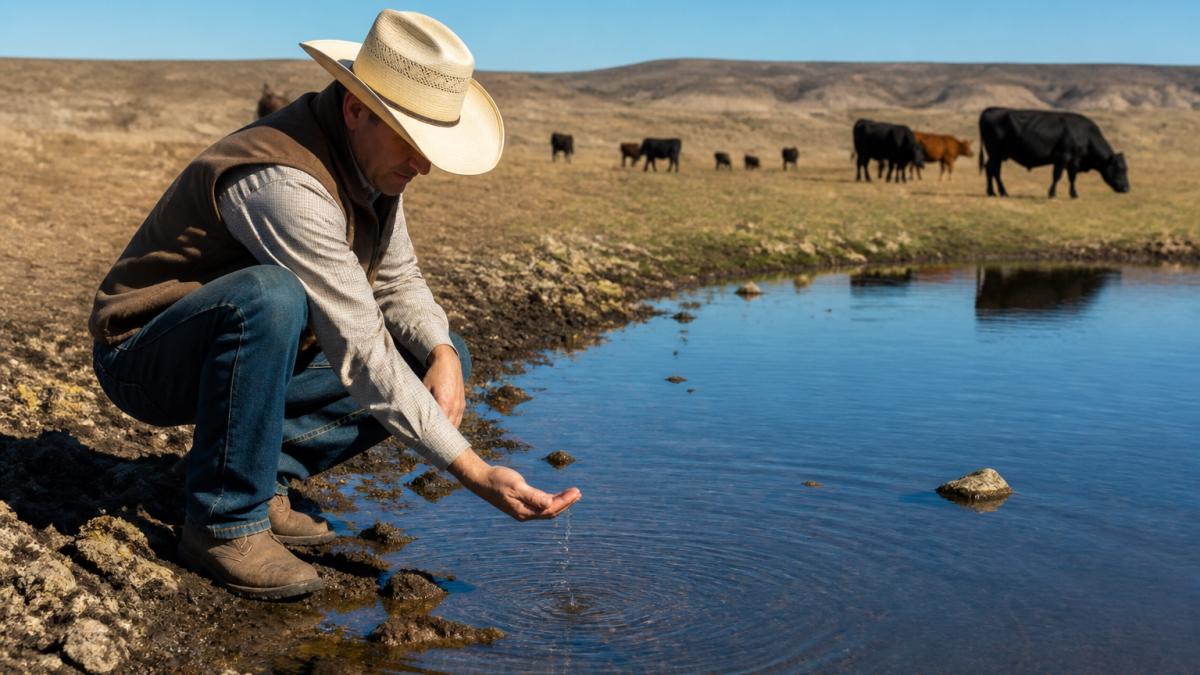
Reliable water access dictates where your herd will congregate, which in turn defines the perimeter lines you must establish when preparing land for fencing.
What to Bring and Who to Ask
Bring a notebook, a camera, and a way to mark GPS points on every source, tank, and trough you find.
For the legal side, water rights are a separate question from physical water. We always tell buyers to have a water rights attorney review the property’s rights before closing, and to confirm with the county how those rights are recorded.
When you are ready to look at properties, start with our cattle ranches for sale in Northern California and we can walk the water with you.
Step 5: Decide Between Year-Round Cattle Grazing and Seasonal Use
Year-round cattle grazing requires enough feed and water for every month, including the hard ones.
The trade-off is simple:
- Year-round: fewer cows, more management, steady income
- Seasonal: more cows, shorter window, you need another place to go
Match the season of use to the rest of your operation before you fall in love with a property.
Step 6: Inspect Cattle Ranch Fencing and Working Facilities
Fencing and working facilities decide how much of your day goes to moving cattle instead of everything else. Cattle ranch fencing and working facilities are the improvements you will use every week.
Check for:
- Fence condition, corners, and gates
- Cross-fencing that lets you rotate pastures
- A set of corrals that will hold and sort your herd
Walk every fence line you can. A mile of fence that needs replacing is work you are buying. Corrals that fit 50 head will not sort 275 pairs.
Step 7: Weigh Access, Terrain and Usable Acreage
Access and terrain decide how usable the ranch really is. A property with good roads and gentle ground will outwork a bigger ranch you cannot get into.
Look at:
- Road access for stock trailers and hay trucks
- Internal roads and whether they hold up wet
- Slope and how much of the ranch is steep
Usable acreage is the number that pays. Steep, brushy ground may still be good hunting and shade, but it will not carry many pairs. Add up the acres you can actually graze, hay, or work, and compare that number to the asking price, not the total acres.
|
What to Check |
Why It Matters |
What Good Looks Like |
|---|---|---|
|
Carrying capacity |
Sets your herd size |
Pairs matched to forage and season |
|
Forage and soil |
Grows the feed |
Deep soil, good grass, few weeds |
|
Water sources |
Limits grazing |
Spread out, reliable, maintained |
|
Season of use |
Fits your operation |
Winter range or summer ground, not both |
|
Fencing and facilities |
Saves labor |
Sound fence, corrals that fit the herd |
|
Access and terrain |
Decides usable acres |
Good roads, gentle ground, easy gates |
Where to Go From Here
The best ranch for you is the one whose water, forage, and season of use match the herd you plan to run. Get those three right and the rest can be improved over time.
If you are looking at cattle ranches for sale in Northern California, our team can walk properties with you and help you read the land the way a cattleman would. We also offer ranch management for owners who want help with grazing and carrying capacity, and you can see current properties any time.
Frequently Asked Questions
How many cattle can a ranch support year-round?
It depends on the forage the ground actually grows, not the acre count. A broker who runs cattle will walk the pasture, look at grass type and ground cover, and work out how many animal units the land can carry through the season you plan to use it. Willow Creek Ranch in Siskiyou County, for example, runs 150 cows year-round on 726 acres. Ask for the history of the place: how many pairs it ran, and for how long each year.
What determines a ranch’s carrying capacity?
Forage quality and type, soil fertility, terrain, slope, and how much of the acreage is actually usable pasture rather than brush, rock or timber. Water placement matters too, because cattle only graze so far from a drink. Carrying capacity is usually expressed in animal units or pairs, and it changes with the season. Winter range and summer ground carry very different numbers on the same ranch.
What should buyers look for in cattle ranch water sources?
Look at reliability first: does the source hold up in late summer, or does it dry out in a normal year? Check wells, ponds, streams and developed springs, and how they are piped or pumped to tanks and troughs. Ask how water is distributed across the pastures, since scattered water lets cattle use more of the ground.
What is the difference between year-round and seasonal cattle use?
Year-round grazing means the ranch supplies feed and water for cattle through every season, which takes dependable forage and water. Seasonal use means the ground carries cattle for part of the year, such as winter range or summer pasture, and the herd moves on. Know which model fits your operation before you buy.
Buying ranch land is a big decision, and the right property does not always show up on a listing site. Martinez Ranch Management & Real Estate has spent over 60 years matching buyers with ranches in Tehama, Shasta, Siskiyou and Butte counties, and we run cattle ourselves. We know the country, we know what carries a herd, and we can help you find properties that are not on the market. Get in touch and let us help you find the right cattle ranch.